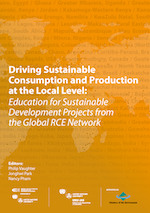
Driving Sustainable Consumption and Production at the Local Level: Education for Sustainable Development Projects from the Global RCE Network
This publication from UNU-IAS features 12 innovative education projects on the topic of sustainable consumption and production (SCP), developed by RCEs around the world. The projects, which all focused on SDG 12 (responsible consumption and production), demonstrate the impact of multi-stakeholder community-based education on SCP, and cover a range of critical factors of SCP: resource efficiency; waste management and minimisation; and consumer behaviour. Each project (also featured in this video) details actions that were taken by the RCE, and invites readers to apply the best practices of multi-stakeholder engagement and action-oriented learning in their regions to promote sustainable consumption and production systems.
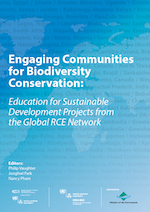
Engaging Communities for Biodiversity Conservation: Education for Sustainable Development Projects from the Global RCE Network
This publication from UNU-IAS highlights innovative biodiversity education projects developed by RCEs throughout the period of the Global Action Programme (GAP) on Education for Sustainable Development (ESD) from 2015-2019. Featured are 12 case studies that focused on SDG 14 (Life Below Water) or SDG 15 (Life on Land), which served to educate, engage, and spur action in communities towards the protection and restoration of ecosystems, species, and habitats. The innovative solutions (also featured in this video) looks at how RCEs, in the face of local biodiversity issues and challenges, developed innovative ways to bring about action through education in their local context and region.
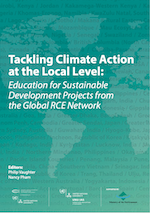
Tackling Climate Action at the Local Level: Education for Sustainable Development Projects from the Global RCE Network
This publication from UNU-IAS highlights outstanding climate education projects from across the Global RCE Network to implement the SDGs through education at the local and regional levels during the Global Action Programme (GAP) on Education for Sustainable Development (ESD) from 2015-2019. The 12 projects featured cover a broad range of sustainable development challenges, however all include a focus on SDG 13 (Climate Action). The innovative solutions (also featured in this video) showcase examples of how global goals can be translated into local actions through education and training to respond to the climate crisis.
RCE Contributions to a More Sustainable World: Celebrating Five Years of Innovative Projects on Education for Sustainable Development (2015-2019)
This publication highlights and celebrates some of the outstanding contributions that RCEs have made to implement the United Nations’ Sustainable Development Goals (SDGs) through education at local and regional levels, during the first five years of the SDGs as well as the Global Action Programme (GAP) on Education for Sustainable Development (ESD) from 2015-2019. Featuring 12 education projects which have all been recipients of the RCE Awards over the last five years, the collection of case studies demonstrate how RCEs have addressed local sustainable development challenges with innovative solutions, and provide diverse examples of how the SDGs can be implemented at the local level through quality education, training and public awareness.
Multi-stakeholder Approaches to Education for Sustainable Development in Local Communities: Towards Achieving the Sustainable Development Goals in Asia
This publication from UNESCO Bangkok and UNU-IAS, ‘Multi-stakeholder Approaches to Education for Sustainable Development in Local Communities: Towards Achieving the Sustainable Development Goals in Asia’, presents a collection of case studies from RCEs in the Asia-Pacific region, demonstrating innovative approaches to ESD through multi-stakeholder partnerships at the local level.
RCE Project Trends during the Global Action Programme on ESD (2015-2019)
During the Global Action Programme (GAP) on ESD, from 2015-2019, RCEs conducted close to 480 projects across 46 countries. Following on from the video released in 2020 highlighting the research that was conducted on these projects, this booklet presents this analysis in full. Covering RCE projects at a global and regional level, the analysis conducted by Dr. Philip Vaughter (Research Fellow, UNU-IAS) and Dr. Fumiko Noguchi (Research Fellow, UNU-IAS) looks at the SDGs, themes, institutions, audiences and environments across the RCE projects completed, which highlight the areas and initiatives undertaken within the network for transformative learning at the local level.
Good Practices for ESD: Case Reports from Japanese RCEs
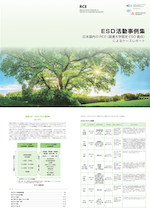
This publication aims to further develop Japanese RCE activities by presenting their good practices in ESD and how they contribute to global RCE activities.
Good Practices for ESD: Case Reports from Japanese RCEs
This publication aims to further develop Japanese RCE activities by presenting their good practices in ESD and how they contribute to global RCE activities.
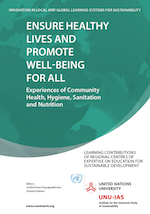
Ensure Healthy Lives and Promote Well-being For All: Experiences of community health, hygiene, sanitation and nutrition within Regional Centres of Expertise on ESD
Globally, the world faces many health-related challenges, from gaps in health literacy to inadequate health systems. Addressing these issues is complex but achievable, with health education and providing safe learning environments being some of the significant contributors to ensuring healthy lives for individuals and communities. The Education for Sustainable Development Programme at UNU-IAS has worked with Regional Centres of Expertise (RCEs) worldwide on a series of case studies to showcase their sustainability initiatives in the areas of health, including proximate determinants and drivers of health such as hygiene, sanitation and nutrition. These highlight how collective action at a local level is critical for addressing the health challenges the world faces today, through a participatory approach and multi-stakeholder networking.
Academia and Communities: Engaging for Change – Learning Contributions of RCEs on ESD
Increasingly, higher education institutions (HEI) and other knowledge organizations engaged with research and education are focusing on how they can address sustainable development challenges. A key to solving such complex problems is knowledge co-creation involving a variety of forms of cooperation among diverse stakeholders. The Education for Sustainable Development Project at UNU-IAS has worked with Regional Centers of Expertise (RCEs) worldwide to look at how this can be fostered through the engagement of knowledge institutions and communities, including at the local level. These contributions look at the ways in which local development problems can be approached through a variety of ESD forms and practices initiated by the multi-stakeholder networks of the RCEs, and which contribute to the ambitions of the GAP (Global Action Programme on ESD).